




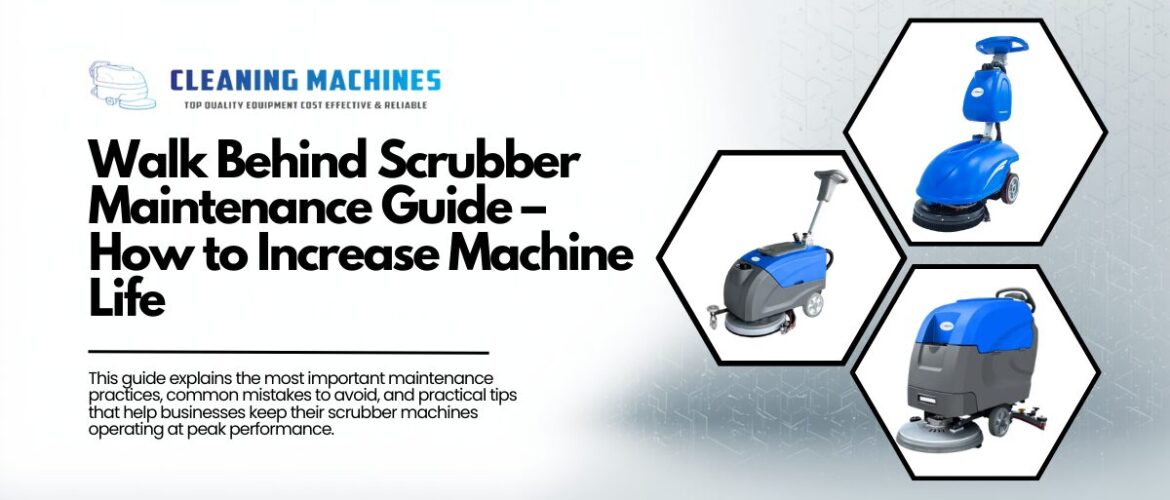
Buying a commercial floor scrubber is a serious investment. But here’s the part most businesses get wrong: the machine’s real lifespan isn’t decided at the time of purchase — it’s decided every single day it’s used afterward.
At Cleaning Machines, we work with facility managers across warehouses, hospitals, retail chains, and manufacturing plants every week, and the pattern is always the same. Two identical scrubbers, bought on the same day, can end up with completely different lifespans — one lasting 8+ years, the other needing major repairs in year two. The difference is almost never the machine. It’s the maintenance routine behind it.
This guide breaks down exactly how to maintain a walk behind scrubber the right way — based on real operational practices we recommend to our own customers running ScrubX machines daily.
Why Walk Behind Scrubber Maintenance Actually Matters
A commercial scrubber isn’t a simple appliance — it’s a system of moving parts working together under constant stress: water, cleaning chemicals, friction, and daily floor traffic. Every one of those elements slowly wears down brushes, seals, tanks, and battery components if left unchecked.
Neglecting maintenance doesn’t just risk a breakdown. It quietly erodes four things at once:
| What Gets Affected | How Maintenance Protects It |
|---|---|
| Machine lifespan | Prevents premature wear on motors, brushes, and tanks |
| Cleaning quality | Keeps suction, brushes, and squeegees performing at full strength |
| Battery health | Protects runtime and delays costly battery replacement |
| Total cost of ownership | Small fixes now avoid expensive repairs later |
Machines like the ScrubX 50 Walk Behind Floor Scrubber, built for high-traffic commercial spaces, are engineered to handle heavy daily use — but that durability only holds up when paired with consistent upkeep. The same applies to compact models like the ScrubX 30 Folding Hand Push Scrubber, which are often mistakenly treated as “low maintenance” simply because they’re smaller.
The 5 Most Common Maintenance Mistakes Operators Make
Most scrubber problems we see aren’t manufacturing defects — they’re preventable habits. Here’s what to watch for:
1. Skipping the recovery tank cleanout. Dirty water left sitting overnight breeds bacteria, causes odors, and clogs the suction system over time.
2. Ignoring brush wear until it’s obvious. By the time bristles are visibly flattened, cleaning quality — and motor strain — has already been compromised for weeks.
3. Careless battery charging habits. Leaving batteries discharged overnight, overcharging, or ignoring corroded terminals is the single biggest cause of early battery failure in machines like the ScrubX 55 Self-Driving Floor Scrubber.
4. Using the wrong cleaning chemicals. Harsh or incompatible solutions degrade seals, hoses, and internal tanks — damage that’s often mistaken for “normal wear.”
5. Skipping the pre-shift inspection. A 60-second check for loose hoses, worn pads, or blocked filters catches most problems before they become breakdowns.
Daily Maintenance: The Routine That Matters Most
Daily care is the single highest-leverage habit for extending scrubber life. It takes a few minutes and should be non-negotiable, regardless of machine size — from the compact ScrubX 40 to larger units like the ScrubX 45.
End-of-shift checklist:
- Empty and safely dispose of the recovery tank’s dirty water
- Rinse the recovery tank with clean water
- Empty and rinse the solution tank to prevent chemical residue buildup
- Remove hair, debris, or string wrapped around brushes or pads
- Wipe down squeegee blades and check for cracks or damage
- Check hoses and filters for clogs or blockages
- Leave tanks open so the machine air-dries fully before storage
This five-minute routine is the foundation every other maintenance practice builds on.
Brush and Pad Replacement: How to Know When It’s Time
Brushes and pads do the actual scrubbing work, so their condition directly determines cleaning results. Heavier-duty machines like the ScrubX 50D Two Methods Self-Driving Scrubber typically need more frequent checks due to higher usage volume.
Warning signs it’s time to replace:
- Flattened or bent bristles
- Uneven wear across the brush surface
- Noticeably reduced scrubbing pressure
- Streaky or inconsistent floor results
Typical replacement schedule:
| Usage Level | Inspection Frequency | Replacement Estimate |
|---|---|---|
| Light commercial use | Every 2 weeks | 6–12 months |
| Medium commercial use | Weekly | 4–8 months |
| Heavy industrial use | Weekly | 3–6 months |
Battery Care: The Maintenance Area Most Businesses Underestimate
Battery health is often the deciding factor in how productive a scrubber fleet actually is. Autonomous and self-driving models — like the ScrubX 55 and the ScrubX Robotics S79 Indoor Commercial Floor Scrubbing Robot — depend on consistent battery performance to complete full cleaning cycles without interruption.
Battery best practices:
- Recharge after every shift — never let batteries sit discharged
- Avoid deep discharging, which accelerates degradation
- Keep terminals clean and corrosion-free
- Check water levels regularly on lead-acid batteries
- Only use manufacturer-approved chargers
Done consistently, these habits can add years to a battery’s usable life.
Building a Long-Term Maintenance Strategy
Extending scrubber life isn’t about one-off fixes — it’s about building a system. Facilities that get the most value from their equipment tend to follow the same five practices:
- Set a fixed maintenance schedule rather than relying on memory or ad hoc checks
- Train every operator, not just senior staff, on proper daily care
- Store machines correctly — dry, temperature-stable, tanks empty and clean
- Standardize on manufacturer-approved chemicals to protect seals and pumps
- Book professional servicing at set intervals, not just when something breaks
When to Call in Professional Servicing
Some issues go beyond routine care and need a trained technician. Contact a professional if you notice:
- Reduced suction power
- Water leaking from tanks or hoses
- Irregular or patchy scrubbing patterns
- Unusual noise from the motor
- Noticeably shorter battery runtime
Left unaddressed, these signs often lead to major component failure — and a far bigger repair bill than a scheduled inspection would have cost.
Why Businesses Across Canada Choose Cleaning Machines
Cleaning Machines has built its reputation on engineering commercial-grade equipment that’s genuinely built to last — and on giving customers the guidance to keep it that way. Our ScrubX lineup, from the compact ScrubX 30 to the fully autonomous ScrubX Robotics S79, is trusted across warehouses, hospitals, retail facilities, airports, shopping malls, and manufacturing plants nationwide.
We don’t just sell scrubbers — we support the businesses running them, with the servicing, parts, and expertise needed to get the full lifespan out of every machine.
Frequently Asked Questions
How often should a walk behind scrubber be professionally serviced?
Most commercial scrubbers should be professionally inspected once or twice a year, though daily-use facilities may need more frequent servicing to keep motors, pumps, and electrical systems in good condition.
How long do commercial floor scrubbers typically last?
A well-maintained machine typically lasts 5 to 10 years. Actual lifespan depends heavily on usage intensity, daily care, and battery maintenance.
What daily maintenance does a scrubber need?
Emptying and rinsing both tanks, cleaning brushes and pads, checking squeegees, and inspecting hoses for blockages — a routine that takes just a few minutes but prevents most common failures.
Can poor maintenance damage scrubber batteries?
Yes. Deep discharging, inconsistent charging, and dirty terminals are among the leading causes of premature battery failure in commercial scrubbers.
What’s the single most important maintenance habit?
Daily tank cleaning. It’s the simplest habit and the one most often skipped — and it directly prevents odor, clogging, and reduced suction over time.
