

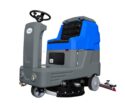



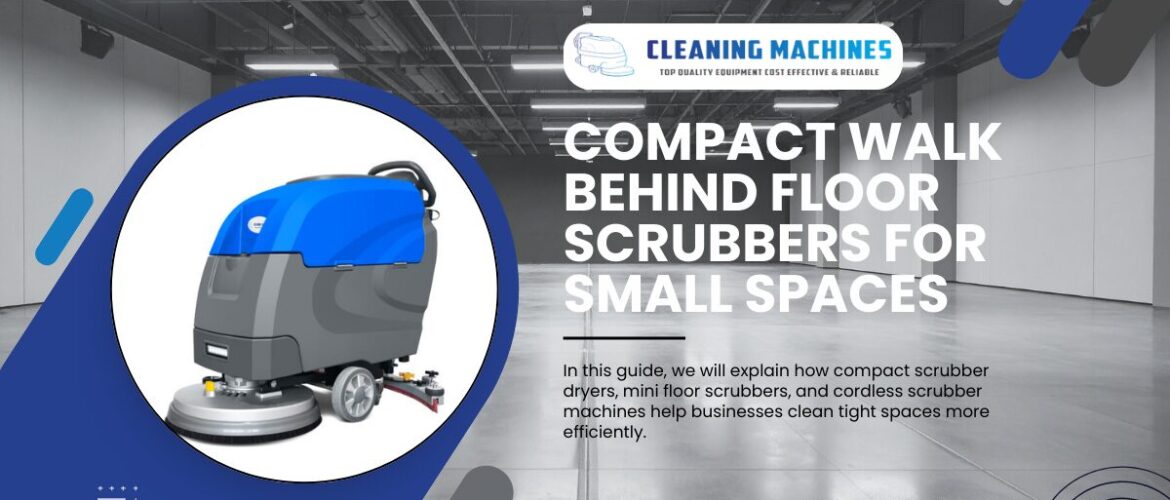
Small commercial facilities face a cleaning problem that most equipment isn’t built for: heavy daily foot traffic packed into a limited footprint. A convenience store, a dental clinic, a school corridor, or a 2,000-square-foot café doesn’t need an industrial ride-on machine — it needs a walk behind floor scrubber sized, weighted, and engineered specifically for tight layouts.
This guide breaks down what actually separates a good small-space scrubber from a bad one, how to evaluate specifications instead of marketing copy, and how to match a machine to your facility type, floor surface, and cleaning frequency.
What Is a Walk-Behind Floor Scrubber?
A walk-behind floor scrubber (also called an auto scrubber or scrubber-dryer) is a self-contained machine that scrubs, rinses, and vacuums up dirty water in a single pass. It combines four core systems:
- Solution tank – holds clean water and detergent
- Scrub deck – a rotating disc brush or cylindrical brush assembly that agitates and lifts soil
- Squeegee assembly – pulls the wastewater into a recovery path
- Recovery tank and vacuum motor – suctions dirty water off the floor immediately, leaving the surface dry and safe to walk on within minutes
Unlike a mop and bucket, an auto scrubber never redeposits dirty water back onto the floor. That distinction is the main reason facilities managers replace manual mopping with mechanical scrubbing once traffic volume increases.
Why Small Facilities Need a Different Machine Than Large Ones
Scrubber sizing is usually described by scrub path width (the cleaning swath per pass, typically 11″–20″ for compact models) and turning radius. Large ride-on or industrial walk-behind units are optimized for open-floor efficiency — wide aisles, warehouses, big-box retail. They struggle in:
- Narrow aisles between shelving or display units
- Tight corners around counters, tables, and equipment
- Facilities with limited janitorial closet space
- Environments that can’t tolerate long charging cables or hoses across walkways
A compact walk-behind scrubber solves this with a narrower scrub path, a tighter turning radius, lighter overall weight, and often a foldable or adjustable handle for closet storage.
Specifications That Actually Matter for Small Spaces
Most product pages lead with horsepower or tank size. For a small facility, prioritize these instead:
| Specification | Why It Matters in Small Spaces |
|---|---|
| Scrub path width | Narrower path (11″–17″) clears aisles and doorways more easily |
| Turning radius | Tighter radius means fewer missed corners and less repositioning |
| Machine weight | Lighter machines are easier to lift over thresholds and store on shelving |
| Tank capacity | Smaller tanks (3–13 gallons) mean less water weight, but more refill trips — balance against your square footage |
| Battery type (AGM vs lithium-ion) | Lithium-ion charges faster and has a longer usable life; AGM is lower upfront cost |
| Battery runtime | Match runtime to your daily cleaning window, not just total square footage |
| Handle design | Foldable handles are essential if storage space is limited |
| Brush type (disc vs cylindrical) | Cylindrical brushes handle debris pickup better; disc brushes are often better for polishing and buffing |
Walk-Behind vs Ride-On vs Manual Mopping
| Factor | Manual Mop | Walk-Behind Scrubber | Ride-On Scrubber |
|---|---|---|---|
| Best facility size | Under 5,000 sq ft, low traffic | 2,000–30,000 sq ft | 30,000+ sq ft |
| Water hygiene | Redeposits dirty water | Recovers water immediately | Recovers water immediately |
| Maneuverability in tight spaces | High, but labor-intensive | High | Low |
| Labor cost over time | Highest | Moderate | Lowest per sq ft, but only at scale |
| Storage footprint | Minimal | Small to moderate (foldable options) | Large |
For most retail stores, clinics, schools, cafés, and small warehouses, a walk-behind scrubber is the point where cleaning stops being manual labor and starts being a repeatable, measurable process — without requiring the storage space or turning radius a ride-on machine demands.
Where Walk-Behind Scrubbers Get Used in Small Facilities
- Restaurants and cafés — grease and beverage spills near counters and seating
- Retail stores — entrance mats, checkout zones, and aisles with constant foot traffic
- Medical and dental clinics — infection-control floor standards in corridors and waiting areas
- Schools — cafeterias, hallways, and gymnasiums between classes
- Small warehouses and distribution rooms — narrow racking aisles where a forklift-scale machine can’t turn
If your facility falls into one of these categories, browse our walk-behind scrubber collection to compare models by scrub path width and battery runtime side by side.
How to Choose the Right Walk-Behind Scrubber
Work through these five questions before comparing models:
- What’s your narrowest aisle or doorway? This sets your maximum scrub path width and machine width.
- What’s your floor surface? Sealed concrete, VCT tile, and epoxy each pair better with different brush types and pad grits.
- How many hours per day will it run? This determines whether you need AGM or lithium-ion batteries, and what tank size avoids constant refilling.
- Who’s operating it? Lighter machines with simpler controls reduce training time for part-time or rotating cleaning staff.
- Where will it live when it’s not in use? If your janitorial closet is small, a foldable-handle model is non-negotiable.
If you’re unsure which class fits your square footage, our compact scrubber buying guide walks through sizing by facility type in more detail.
Maintenance and Safety Practices That Extend Machine Life
A walk-behind scrubber is a mechanical system, and neglecting basic maintenance is the most common reason facilities replace machines early:
- Rinse tanks after every shift. Detergent residue left in solution tanks causes odor and clogs the solenoid valve.
- Inspect squeegee blades weekly. A worn or nicked squeegee is the top cause of streaking and poor water pickup — not the brush.
- Rotate or replace brushes on schedule. Worn bristles reduce scrub pressure even if the motor is fine.
- Follow battery charge cycles precisely. Deep-cycling AGM batteries below manufacturer thresholds shortens their lifespan significantly; lithium-ion is more forgiving but still benefits from scheduled charging routines.
- Check for ANSI/NFSI slip-resistance compliance on your floor finish after scrubbing, particularly in healthcare and food-service settings where wet-floor liability is a real operational risk.
These habits matter for EEAT reasons beyond SEO, too — they reflect the kind of first-hand operational knowledge that separates a facilities team that’s actually run these machines from one that’s only read a spec sheet.
Cost Comparison: Mopping vs. Walk-Behind Scrubbing
| Factor | Manual Mopping | Walk-Behind Scrubber |
|---|---|---|
| Labor hours per 1,000 sq ft | Higher — repeated passes, wringing, bucket changes | Lower — single-pass scrub and dry |
| Water usage | Higher, frequently replaced | Controlled flow with recovery |
| Chemical usage | Often over-applied | Metered through solution tank |
| Floor lifespan impact | Streaking and residue buildup over time | Consistent clean reduces long-term wear |
Facilities that switch from mopping to a compact scrubber typically see the return on investment through reduced labor hours rather than the upfront machine cost — which is why sizing the machine correctly to your space matters more than choosing the cheapest option.
Frequently Asked Questions
Is a walk-behind scrubber worth it for a facility under 3,000 square feet? Yes, if the space sees daily traffic or frequent spills. Below that size with light traffic, a high-quality mop system may still be sufficient — the deciding factor is cleaning frequency, not just square footage.
Can one walk-behind scrubber handle multiple floor types? Most can, provided you swap pads or brushes appropriate to the surface. Sealed concrete, VCT, and epoxy each respond differently to brush aggressiveness, so check manufacturer pad guidance rather than assuming one setup works everywhere.
How often should brushes and squeegees be replaced? Squeegee blades typically need replacement every 1–3 months in daily-use facilities; brushes vary by material and traffic but should be inspected monthly for bristle wear.
Do walk-behind scrubbers work on carpet? No — standard walk-behind scrubbers are built for hard flooring. Carpeted areas need a separate carpet extractor.
What’s the real difference between AGM and lithium-ion batteries in these machines? AGM batteries cost less upfront but degrade faster with deep discharges and need longer charge times. Lithium-ion batteries charge faster, last more charge cycles, and tolerate partial charging better — which matters most for facilities cleaning multiple times per day.
