






Floor Scrubbers in Canada
Based in Ontario, Cleaning Machines ships floor scrubbers to businesses across Canada, backed by local after-sales support and hands-on product guidance—not just a warehouse and a shipping label.
For over a decade, Cleaning Machines has helped warehouses, retail chains, gyms, schools, and facility service providers across the Greater Toronto Area upgrade from manual mopping to automated floor scrubbing. We’ve fitted out everything from single location gyms to multi-site warehouse operations, and that hands-on experience shapes every recommendation. Our in-stock lineup ranges from compact walk-behind scrubbers for tight retail aisles to heavy-duty ride-on machines built for round-the-clock industrial use.
Looking for a floor scrubber in Canada? Whether you need an automatic floor scrubber for daily maintenance cleaning or a heavy-duty unit for round-the-clock industrial use, our in-stock lineup covers every facility size and budget across the GTA.
Read more
Read less
What Is a Floor Scrubber Machine?
A floor scrubber is an automated cleaning machine that scrubs, washes, rinses, and dries hard flooring in a single pass—and if you’re searching for a floor scrubber in Toronto or the GTA, this is the category to start with.
Depending on model and tank size, our floor scrubbers can cover up to 2,000 m² per hour — enough to clean an entire warehouse floor or retail aisle in a single pass.
Why Businesses Invest in a Floor Scrubber
Clean, hygienic flooring isn’t just cosmetic — it affects safety compliance, customer perception, and staff productivity. Compared to manual mopping, a floor scrubber machine:
- Cleans significantly faster, freeing up janitorial staff for other tasks
- Uses less water and detergent per square foot
- Lifts ground-in dirt and grease that mopping simply spreads around
- Leaves floors dry within minutes, reducing slip-and-fall risk
Businesses often compare a commercial floor cleaning machine to a basic floor cleaner machine before buying, the difference comes down to automation. A dedicated floor scrubbing machine washes, scrubs, and dries in one pass, while a simple floor washer scrubber may still need a separate mop-up step. For most facilities, an auto scrubber machine works out cheaper per square foot over time than manual cleaning.
Whether you need a commercial floor scrubber for an office or retail environment, or an industrial floor scrubber for a warehouse or plant floor, matching the machine to your facility is what actually delivers the labor and cost savings.
1. Commercial Floor Scrubbers — Built for Business Spaces
Our lineup spans compact [14-inch] models built for tight aisles and storage rooms up to [26-inch] machines designed for large open-floor commercial spaces so you’re not paying for more machine than your facility needs.
Commercial floor scrubbers are sized and tuned for malls, hospitals, schools, restaurants, and office buildings, where the priority is a polished appearance without disrupting daily operations.
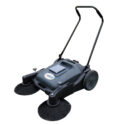
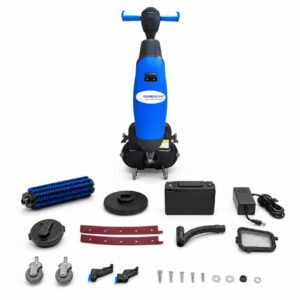
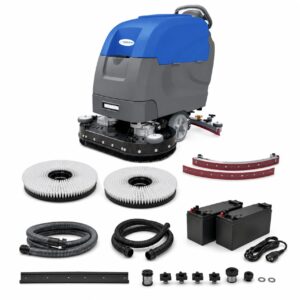
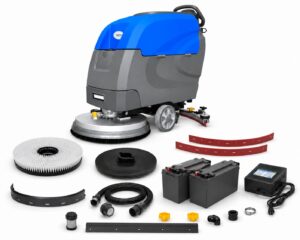
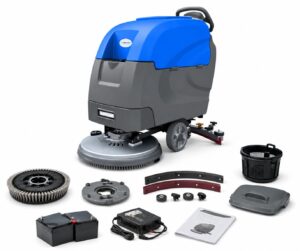
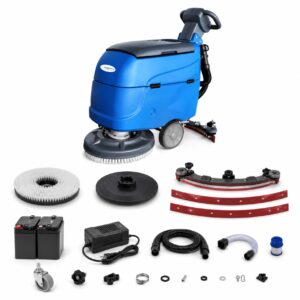
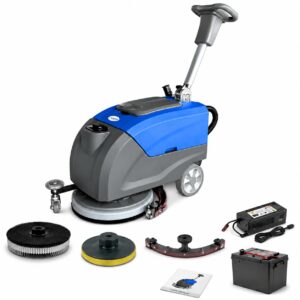
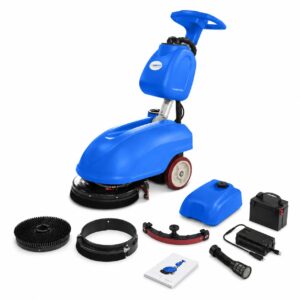
Walk-behind floor scrubbers are the most common choice here — maneuverable enough for aisles and corridors, yet powerful enough for daily wear-and-tear cleaning.
What this category delivers:
- Fast coverage of large floor areas with minimal operator effort
- Stain and soil removal without scratching or dulling the surface
- Lower cleaning labor hours per shift
- Dry, slip-resistant floors immediately after use
Within this range, a walk behind floor scrubber machine is the most requested option for daily commercial upkeep. Options include a simple walk behind floor machine for basic maintenance, a fully manual walk behind floor cleaner, a battery-powered walk behind automatic scrubber, and self-propelled walk behind floor scrubbers for larger footprints — all part of our full range of floor scrubbing machines built for everyday commercial use.
Best suited to retail stores, offices, schools, and hotels handling light-to-moderate foot traffic. If you’re comparing floor scrubber options in Canada, this is typically the category that fits general commercial cleaning budgets and footprints.
2. Industrial Floor Scrubbers — Heavy-Duty Cleaning at Scale
Industrial floor scrubbers are engineered for high-traffic, high-soil environments: warehouses, manufacturing plants, airports, and large-format retail. These machines trade some maneuverability for tank size, motor power, and durability.
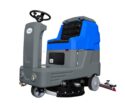
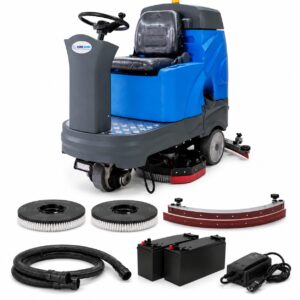
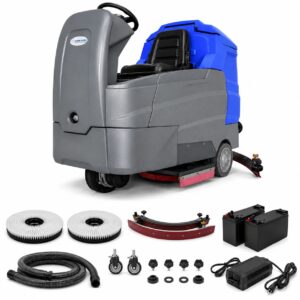
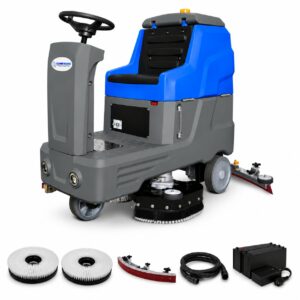
Ride-on floor scrubbers dominate this category — ideal for factories, logistics centers, and airports, and increasingly used in large commercial spaces like malls and convention centers where square footage is the main constraint.
Why facility managers choose industrial-grade machines:
- Higher-torque motors and larger tanks for extended deep-cleaning runs
- Proven performance against grease, oil, and industrial-grade debris
- Battery-electric and traditional models depending on facility power setup
- Compatibility with concrete, sealed tile, and epoxy-coated flooring
Best for: facilities that need to maintain OSHA-aligned floor safety standards while processing large volumes of debris and contamination daily.
How to Choose the Right Floor Scrubber: A Buyer’s Framework
Selecting the right machine comes down to six factors we walk every customer through before recommending a model.
Tank Capacity — Runtime vs. Refill Frequency
Tank size determines how long you can run before stopping to empty or refill.
- Industrial machines: typically 30–100+ gallon clean/recovery tanks, built to minimize downtime across large warehouses, plants, or airport terminals.
- Commercial machines: usually 10–25 gallons, which is manageable for offices, retail, and schools where short refill breaks aren’t disruptive.
Buying tip: Prioritize machines with separate clean and recovery tanks to prevent cross-contamination, and consider water-recycling systems if reducing water usage matters to your operation.
Brush Pressure — Matching Power to Surface
Brush pressure needs to match what’s actually on your floor.
- High pressure (200–500 RPM): needed for stripping oil, grime, and heavy soiling from concrete in industrial settings.
- Low-to-medium pressure (100–200 RPM): protects finished surfaces like epoxy, vinyl, or hardwood common in commercial spaces.
Look for downward pressure control and interchangeable brush/pad options — stiff bristles for embedded stains, softer pads for polished finishes. A hospital corridor and a mechanic’s bay have very different needs, and the right machine should adjust to both.
Battery Life — Keeping Pace With Your Shift
- Industrial facilities running extended or 24/7 operations typically need 6–8 hours of runtime per charge.
- Commercial environments generally get by with 4–6 hours for standard daily cleaning.
Lithium-ion batteries are worth the premium: faster charging, longer service life, and no maintenance watering. Opportunity charging — topping up during short breaks without battery damage — is a useful feature for high-demand sites. For continuous operations, keeping a spare battery on hand avoids mid-shift downtime.
Maneuverability — Getting Into (and Around) Everything
- Zero-turn radius matters most in cluttered industrial layouts with racking and equipment.
- Swivel steering helps commercial scrubbers navigate around furniture, fixtures, and tight corners.
Compact walk-behind designs suit narrow aisles; ride-on units make sense once you’re covering large, open industrial floor plans.
Versatility — One Machine, Multiple Surfaces
Interchangeable brushes, pads, and settings let a single machine handle more than one job:
- Commercial settings: switching between grocery tile and polished mall flooring
- Industrial settings: moving from bare concrete to degreasing tasks on the same shift
Diamond-embedded pads work well for polishing high-traffic retail floors, while cylindrical brushes handle textured industrial surfaces more effectively. Onboard tool storage is a small feature that meaningfully speeds up daily workflow.
Support, Parts & Warranty — The Trust Factor
A scrubber is a long-term equipment purchase, so the buying decision shouldn’t stop at specs. Ask about:
- Warranty length and what it actually covers (motor, batteries, frame)
- Local parts availability and turnaround time for repairs
- Access to trained service technicians in your area
- Whether the supplier offers a demo or trial period before purchase
This is where working with an established, regionally-based supplier pays off — fast access to parts and service keeps your machine (and your cleaning schedule) running without extended downtime.
Floor Scrubbers Available Across Canada
We supply floor scrubbers canada-wide, with same-week delivery available for businesses across the GTA. Whether you’re comparing floor scrubbers ontario options for a single retail location, or sourcing auto scrubbers canada-wide for a multi-site operation, our team can match the right machine — walk behind or ride-on — to your floor plan and budget. Local customers often search for a walk behind scrubber toronto or walk behind floor machines toronto, and we stock both in our GTA warehouse for fast pickup and delivery. We also ship a walk behind floor scrubber canada-wide for businesses outside the GTA.
Find the Right Floor Scrubber for Your Facility
Our team has spent years matching Toronto-area businesses with the right commercial or industrial floor scrubber for their specific floor type, traffic volume, and budget — not just selling the highest-spec machine available. If you’re ready to compare options or want a recommendation based on your facility’s square footage and flooring, get in touch and we’ll walk you through it.
From single walk behind scrubbers to full fleets of commercial floor scrubbers — including commercial floor scrubber canada-wide delivery — we help Toronto-area businesses find the right fit. Browse our in-stock floor cleaners for sale below, or contact us if you’re looking for the best floor cleaning machine for a specific flooring type or facility size.
Every machine ships with in-house delivery for safer transit, nationwide coverage across Canada, and after-sales support that continues long after your purchase.
Contact us today to find the right floor scrubber machine for your business.
Frequently Asked Questions
1. What is a floor scrubber machine?
An automated cleaning device that scrubs, washes, and dries hard floors in a single pass, commonly used across commercial and industrial facilities.
2. What’s the difference between a commercial and an industrial floor scrubber?
Commercial floor scrubbers are built for offices, malls, and public spaces with moderate cleaning demands. Industrial floor scrubbers are built for heavier-duty cleaning in warehouses, factories, and large-scale facilities, with bigger tanks and stronger motors.
3. How often should I use a floor scrubber?
It depends on foot traffic and facility type. High-traffic spaces like malls or hospitals often need daily cleaning, while warehouses may only need weekly or bi-weekly scrubbing.
4. What type of floor scrubber is best for large areas?
A ride-on floor scrubber generally covers the most ground per hour, making it the most labor-efficient option for large facilities.
5. Can floor scrubbers be used on any type of flooring?
Most flooring types can be scrubbed, but the right model matters — some machines are built for hardwood, tile, and marble, while others are designed specifically for concrete and epoxy-coated surfaces.
6. How do I maintain a floor scrubber machine?
Regular upkeep includes cleaning brushes and pads after each use, emptying and rinsing the recovery tank, checking and replacing squeegees as needed, and properly charging the battery on battery-operated models.
7- Can you use a floor scrubber on concrete floors?
Yes. Floor scrubbers are widely used on concrete, especially in warehouses, garages, and industrial facilities. For bare or sealed concrete, look for a machine with higher brush pressure (200–500 RPM) and stiffer brushes to lift ground-in dirt, oil, and grease without damaging the surface.
8. Can you use a floor scrubber on laminate floors?
Floor scrubbers can be used on laminate, but caution is needed — excess water and high brush pressure can damage laminate’s protective layer over time. Choose a model with adjustable low-pressure settings and soft pads, and avoid oversaturating the surface. For daily laminate maintenance, a compact walk-behind or hand-push scrubber is usually the safer choice.
9- How long do floor scrubber batteries last?
Battery runtime depends on the machine and usage. Commercial floor scrubbers used for standard daily cleaning typically run 4–6 hours per charge, while industrial models built for extended or 24/7 operations can run 6–8 hours. Lithium-ion batteries charge faster, last longer overall, and support opportunity charging during short breaks.
10- What’s the best floor scrubber for a small or medium-sized business?
For most small-to-medium commercial spaces, a compact walk behind scrubber offers the best balance of cost, coverage, and ease of use. If your business handles higher foot traffic or larger square footage, stepping up to a heavier-duty floor machine scrubber — or a larger-tank scrub machine for floors — will reduce refill stops and improve efficiency.
