




Walk into any warehouse, distribution center, or manufacturing plant across Canada during shift change, and you’ll notice the same problem: concrete floors covered in oil residue, tire marks, salt brine tracked in from the parking lot, and fine dust that a push broom simply redistributes rather than removes. This isn’t a cosmetic issue — it’s an operational and safety one. Health Canada and provincial workplace safety boards (like WSIB in Ontario and WorkSafeBC) consistently flag slip-and-fall incidents on unclean industrial floors as among the top preventable workplace injuries.
This guide breaks down everything a facility manager, cleaning contractor, or business owner needs to know before buying an industrial floor scrubber in Canada — from machine types and technical specifications to maintenance routines that actually extend equipment lifespan.
What Is an Industrial Floor Scrubber, Really?
An industrial floor scrubber is an automated cleaning machine that combines three functions in a single pass: dispensing a water-and-detergent solution, agitating the floor surface with rotating or cylindrical brushes (or pads), and immediately vacuuming up the resulting slurry through a squeegee-and-vacuum system. The result is a floor that is not just visibly clean but sanitized and dry within minutes — something a mop-and-bucket routine or even an industrial floor sweeper cannot achieve on its own.
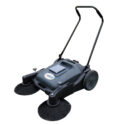
Unlike a floor sweeper, which only collects dry debris, a scrubber performs wet scrubbing, making it the right equipment for facilities dealing with grease, embedded grime, food residue, or de-icing salt.
Why Canadian Facilities Specifically Need Scrubbers
Canada’s climate creates a cleaning challenge most equipment isn’t designed for elsewhere:
- Winter salt and slush: Tracked-in road salt is corrosive to concrete and steel, and it accelerates degradation of epoxy floor coatings if not scrubbed out regularly.
- Heavy foot and forklift traffic: Warehouses and logistics hubs across Ontario, Alberta, and BC run multi-shift operations where floors rarely get a “quiet period” for manual cleaning.
- Regulatory compliance: Facilities in food processing, pharmaceuticals, and healthcare must meet CFIA and provincial hygiene inspection standards — dry mopping alone won’t pass an audit.
This is why more Canadian procurement teams are shifting budget from janitorial labor hours toward owned or leased scrubbing equipment — the ROI shows up within a single fiscal year for most mid-to-large facilities.
Types of Industrial Floor Scrubbers
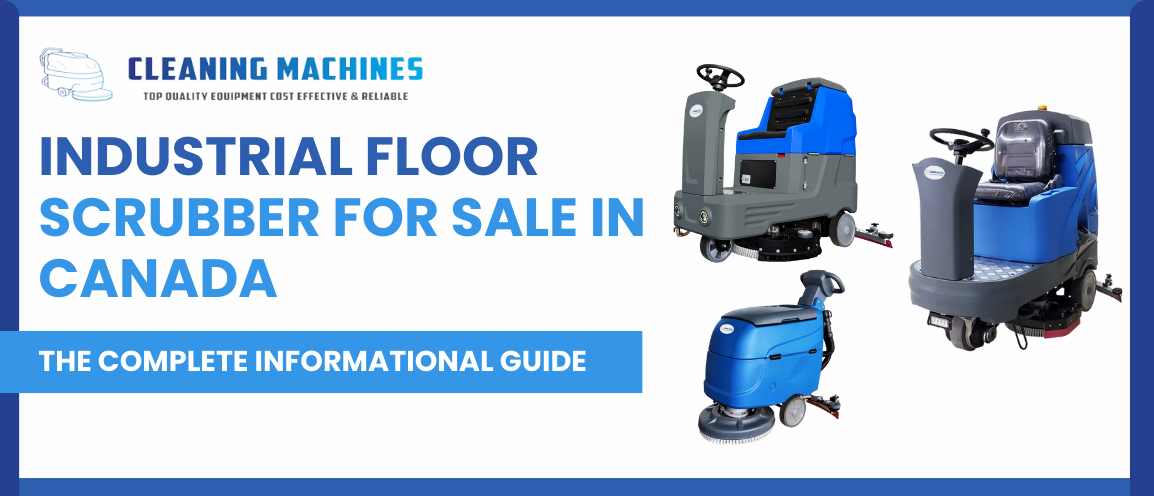
Walk-Behind Floor Scrubbers
Best suited for small to mid-sized footprints — retail backrooms, small warehouses, schools, and clinics. They’re affordable, require minimal training, and maneuver well around shelving and tight corners.
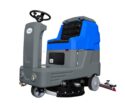
Ride-On Floor Scrubbers
For large-scale operations — distribution centers, airports, arenas, and manufacturing floors exceeding 20,000 sq. ft. — a ride-on floor scrubber dramatically cuts cleaning time and operator fatigue. Many models cover 30,000+ sq. ft. per hour, compared to a fraction of that with walk-behind units.
Compact vs. Large Industrial Scrubbers
Compact scrubbers are built for narrow aisles, elevators, and congested layouts. Large-format machines are engineered for wide-open plant floors where scrubbing width matters more than tight-turn agility.
Battery-Powered vs. Electric (Corded) Scrubbers
Battery models offer full mobility with no cord to manage — ideal for large open floors. Corded electric units are suited to smaller, fixed areas where continuous runtime matters more than mobility.
Key Technical Specifications to Evaluate
| Feature | Why It Matters |
|---|---|
| Tank Capacity | Larger solution and recovery tanks mean fewer refill/dump cycles and higher square-footage-per-hour output |
| Scrubbing Width | A wider deck (20″–34″ for walk-behind; 28″–40″+ for ride-on) directly reduces total cleaning time |
| Brush Pressure (PSI/lbs) | Higher down-pressure is necessary for embedded grime, coated concrete, and industrial coatings |
| Battery Runtime & Charge Cycle | AGM batteries typically run 2–3 hours; lithium-ion units often exceed 4+ hours with faster charging |
| Squeegee & Recovery System | Determines how dry the floor is immediately after the pass — critical for slip-hazard reduction |
| Noise Level (dB) | Relevant for hospitals, retail during business hours, or 24/7 facilities |
Where to Buy Industrial Floor Scrubbers in Canada
Authorized Dealerships
Buying through an authorized cleaning equipment dealer gives you manufacturer-backed warranties, genuine parts availability, and access to certified technicians — something that matters when a machine is down and your cleaning schedule can’t wait.
Online Marketplaces
General marketplaces can offer competitive pricing, but warranty coverage, parts sourcing, and after-sales support are often limited or absent — a real risk for a machine that will run daily.
Local Cleaning Equipment Specialists
Specialized Canadian suppliers typically offer in-person demos, floor-type consultations, and financing/leasing options — valuable for first-time buyers unsure which model fits their facility.
Real Business Benefits of Industrial Scrubbers
- Labor Reallocation: Staff previously assigned to manual mopping can be redeployed to higher-value tasks.
- Hygiene & Compliance: Deep scrubbing removes embedded bacteria and residue that surface mopping leaves behind — critical in food, healthcare, and pharma environments.
- Lower Total Cleaning Cost: Reduced labor hours and chemical usage typically offset equipment cost within 12–18 months for mid-sized facilities.
- Equipment Longevity: Industrial-grade scrubbers are built with commercial-duty motors and brush assemblies rated for daily multi-hour use — unlike consumer-grade alternatives.
How to Choose the Right Scrubber for Your Facility
- Measure your cleaning area. Anything above 15,000–20,000 sq. ft. typically justifies a ride-on unit over walk-behind.
- Identify your floor type. Sealed concrete, epoxy, vinyl composition tile (VCT), and unsealed concrete each respond differently to brush type and pressure — check manufacturer compatibility before buying.
- Assess traffic load. 24/7 or multi-shift facilities need higher-duty-cycle machines and larger battery capacity.
- Set a realistic budget — including total cost of ownership. Factor in batteries, brushes/pads, squeegees, and filters over a 3–5 year lifespan, not just the sticker price.
Maintenance: What Actually Extends Machine Life
Daily
- Empty and rinse recovery and solution tanks (residual chemical buildup damages tank seals over time)
- Wipe down and inspect squeegee blades for nicks or wear
- Clear debris caught in brush/pad assemblies before it hardens
Monthly
- Inspect and clean or replace vacuum motor filters
- Check hoses and fittings for cracking or leaks
- Torque-check loose bolts, casters, and brush deck hardware
Battery Care
Avoid partial charge cycles on lead-acid/AGM batteries — this shortens lifespan significantly. Lithium-ion batteries tolerate partial charging far better and are increasingly the standard choice for facilities running multiple shifts.
When to Replace Parts
Worn brushes lose scrubbing pressure even if they still look intact; squeegees that leave streaking behind are past their usable life; clogged filters silently reduce vacuum recovery efficiency long before they fail completely.
Frequently Asked Questions
How much does an industrial floor scrubber cost in Canada? Walk-behind units generally range from CAD $3,000–$12,000 depending on tank size and battery type, while ride-on scrubbers range from roughly CAD $15,000–$45,000+ depending on scrubbing width, battery technology, and brand.
Can one machine handle both indoor and outdoor areas? Most industrial scrubbers are designed for smooth interior surfaces. Outdoor or rough-surface areas typically require a different brush/pad configuration or a dedicated outdoor sweeper-scrubber combo unit.
How often should a warehouse floor be scrubbed? High-traffic facilities typically scrub daily or every other day; lower-traffic commercial spaces may scrub 2–3 times per week.
Is leasing a scrubber a viable alternative to buying? Yes — many Canadian suppliers offer leasing or rent-to-own programs, which can be a lower-risk entry point for facilities testing whether an owned scrubber fits their operation before committing capital.
Final Thoughts
Choosing the right industrial floor scrubber comes down to matching machine specifications — tank size, scrubbing width, brush pressure, and runtime — to your actual facility conditions, not just picking the biggest or cheapest option available. For most mid-to-large Canadian warehouses and industrial plants, a ride-on scrubber delivers the fastest return on investment through labor savings and consistent hygiene compliance.
Browse our full range of ride-on floor scrubbers to compare tank capacity, scrubbing width, and battery options suited to your facility size.
