




Warehouse cleaning in Canada is not simple surface maintenance. It is operational risk management. Between forklift tire marks, pallet drag scratches, oil drips, concrete dust, and heavy winter salt buildup, warehouse floors face constant abuse. Add large square footage and tight shipping deadlines, and warehouse floor cleaning becomes a productivity issue — not just a hygiene concern.
Choosing the right floor scrubber for warehouse operations in 2026 requires more than comparing tank sizes. Canadian warehouse managers must consider layout constraints, cleaning frequency, labour availability, moisture control, and long-term efficiency. This guide explains how to make the right decision without overcomplicating the process.
Throughout this guide, we will reference practical solutions available through Cleaning Machines, helping you understand which type of equipment fits specific warehouse scenarios — without turning this into a sales pitch.
Why Is Warehouse Floor Cleaning More Demanding Than Other Commercial Spaces?
Warehouse floors operate under industrial stress conditions. Unlike retail stores or office buildings, warehouses experience:
- Continuous forklift traffic
- Heavy load movement
- Concrete dust generation
- Oil and lubricant residue
- Winter salt and moisture intrusion
- Large uninterrupted floor spans
In Canadian climates, winter salt is especially aggressive. Salt residue not only stains concrete but also increases slip risk and accelerates surface wear. Moisture from snow melt can spread across aisles, creating safety hazards.
Traditional mopping simply redistributes dirt and leaves moisture behind. In high-traffic environments, that leads to slippery surfaces and safety concerns. A properly selected industrial scrubber in Canada removes residue, controls water recovery, and supports workplace safety compliance.
For warehouse managers, cleaning is directly tied to:
- Slip-and-fall prevention
- Forklift traction
- OSHA-style safety standards
- Equipment longevity
- Employee morale
This is why warehouse cleaning demands a more strategic equipment choice.
What Size Floor Scrubber Is Best for a Warehouse?
The right scrubber size depends heavily on total square footage and layout density. Bigger is not always better. Oversizing equipment can create maneuverability issues in tight rack aisles, while undersizing leads to extended cleaning time.
| Warehouse Size | Recommended Scrubber Category | Typical Use Scenario |
| Under 10,000 sq ft | Compact / Folding Walk-Behind | Storage rooms, back zones |
| 10,000 – 40,000 sq ft | Mid-Size Walk-Behind | Distribution centres |
| 40,000+ sq ft | Self-Driving Walk-Behind | High productivity warehouses |
A small 8,000 sq ft storage facility with narrow racks may benefit from compact folding machines like ScrubX 30 – Folding Hand Push Floor Scrubber or ScrubX 40 – Foldable Hand Push Scrubber. These models allow easy storage and tight maneuvering.
Mid-sized warehouses often require more productivity. Units similar to ScrubX 45 – Walk Behind Floor Scrubber or ScrubX 50 – Walk Behind Floor Scrubber provide wider cleaning paths while remaining manageable for single operators.
Large warehouses above 40,000 sq ft typically require productivity-focused machines, such as dual-mode options like ScrubX 50D or advanced units such as ScrubX 55, which support extended cleaning coverage.
The key is balancing cleaning speed with aisle accessibility.
How Do You Match Scrubber Type With Warehouse Size?
Warehouse layout matters as much as total area. A 30,000 sq ft facility with wide shipping lanes cleans very differently from a 30,000 sq ft warehouse filled with dense racking.
For compact storage layouts:
Smaller folding machines such as ScrubX MOP – Folding Hand Push Floor Scrubber are practical for spot cleaning and narrow aisle navigation.
For balanced distribution centres:
Mid-sized walk-behind machines provide the right mix of maneuverability and coverage.
For high-volume logistics hubs:
Self-driving assistance improves straight-line productivity in long aisles while reducing operator fatigue.
Canadian warehouse managers should evaluate:
- Aisle width
- Open floor percentage
- Dock areas
- Loading bay moisture zones
- Cleaning frequency (daily vs weekly)
Cleaning Machines often advises buyers to walk their facility and map cleaning routes before selecting a machine. This simple step prevents costly over- or under-purchasing.
When Is a Walk-Behind Scrubber Enough?
For many Canadian warehouses, a traditional walk-behind scrubber remains the most practical solution. These machines are cost-effective, easy to train staff on, and require minimal technical oversight.
Walk-behind scrubbers are ideal when:
- Cleaning is performed once per day
- Labour is available
- Budget is moderate
- Warehouse size is under 40,000 sq ft
- Automation is not yet a priority
They offer strong water recovery, consistent pressure cleaning, and predictable maintenance costs.
In 2026, modern walk-behind machines available through Cleaning Machines have improved battery runtime and recovery systems, making them reliable for mid-scale warehouse floor cleaning.
When Should You Upgrade to a Self-Driving Machine?
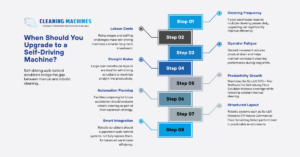
Self-driving walk-behind scrubbers bridge the gap between manual and robotic cleaning. They still require supervision but reduce operator strain and increase straight-line productivity.
Warehouses should consider upgrading when:
- Cleaning requires multiple daily passes
- Labour costs are rising
- Staff fatigue affects cleaning quality
- Large open aisles dominate the layout
Machines such as ScrubX 50D – Two Methods For Self-driving Floor Scrubber or ScrubX 55 – Self-Driving Floor Scrubber allow operators to shift from constant steering to guided movement. Over long shifts, this reduces physical fatigue and supports consistent cleaning patterns.
In high-traffic Canadian logistics centres, this productivity boost can significantly improve efficiency over three to five years.
Is a Robotic Scrubber Practical for Warehouses in 2026?
Automation is becoming more realistic in large Canadian facilities. Robotic scrubbers such as ScrubX Robotics S79 Indoor Commercial Floor Scrubbing Robot are particularly useful in environments with:
- Predictable floor layouts
- Overnight cleaning schedules
- Labour shortages
- High square footage above 60,000 sq ft
However, robotics still require supervision, maintenance planning, and software management. They are most practical in structured environments rather than highly cluttered layouts.
For warehouses preparing for automation expansion, robotic units can supplement — not fully replace — walk-behind systems.
Walk-Behind vs Self-Driving vs Robotic: Operational Comparison
| Feature | Walk-Behind | Self-Driving | Robotic |
| Labour Required | Full-time operator | Assisted operator | Supervised automation |
| Productivity | Moderate | High | Very high (scheduled) |
| Supervision | Direct | Moderate | Technical oversight |
| Investment Level | Moderate | Higher | Highest |
Walk-behind machines remain the backbone of warehouse floor cleaning. Self-driving improves consistency. Robotic solutions maximize automation but require operational readiness.
The right choice depends on long-term strategy — not just price.
How Much Should Canadian Warehouses Budget for an Industrial Scrubber?
Budget planning should consider more than purchase cost. Total cost of ownership includes:
- Battery replacement cycles
- Brush wear
- Maintenance
- Labour hours
- Downtime impact
For example, consider a 35,000 sq ft warehouse cleaning five days per week:
Manual mopping might require 3 labour hours daily. A mid-sized walk-behind could reduce that to 1.5 hours. Over three years, labour savings alone often exceed the price difference between basic and productivity-enhanced machines.
Salt corrosion in winter also increases maintenance frequency. Choosing durable systems available through Cleaning Machines helps reduce long-term service interruptions.
ROI should be measured across 3–5 years, not short-term purchase price.
What Mistakes Should Warehouse Buyers Avoid?
One common mistake is oversizing equipment without considering aisle clearance. Another is underestimating runtime requirements, resulting in mid-shift battery failure.
Other common issues include:
- Ignoring winter salt impact
- Choosing price over durability
- Not evaluating water recovery efficiency
- Skipping staff training
Warehouse cleaning equipment is an operational tool. Poor selection leads to repeated reinvestment.
Consultative planning — such as reviewing options through Cleaning Machines — ensures better long-term alignment with facility growth.
Frequently Asked Questions
What is the best floor scrubber for warehouse cleaning in Canada?
The best option depends on size and layout. Small warehouses may need compact folding units, while mid-sized facilities benefit from walk-behind scrubbers. Larger warehouses often see productivity gains from self-driving models.
How often should a warehouse floor be scrubbed?
High-traffic warehouses typically require daily cleaning. Facilities with heavy forklift use may need spot cleaning throughout shifts to control dust and oil buildup.
Are self-driving scrubbers difficult to maintain?
They require slightly more oversight than standard walk-behind machines but remain manageable with proper training. Maintenance schedules are similar, with added guidance system care.
Is a robotic scrubber worth it for medium warehouses?
Robotics are most effective in large, structured environments. Medium warehouses may see better ROI with productivity-enhanced walk-behind units.
How long does a warehouse scrubber last?
With proper maintenance, most industrial scrubbers operate efficiently for 5–7 years. Battery replacement cycles may occur within that timeframe.
Does winter salt damage scrubber machines?
Salt can increase wear if not cleaned properly. Regular maintenance and corrosion-resistant components help reduce long-term impact.
