




Industrial Walk Behind Scrubber for Heavy Duty Cleaning
Keeping an industrial floor genuinely clean is not the same job as running a mop across an office corridor. Warehouses, production halls, automotive bays, and distribution centers absorb oil, dust, metal shavings, and forklift traffic every single hour of operation. Over time this builds into a layer of embedded grime that ordinary mopping simply cannot lift.
This is the exact gap that industrial walk behind floor scrubbers are built to close. They combine a scrubbing deck, a solution tank, and a vacuum-drying squeegee into one pass, so a facility gets a floor that is washed and dry within seconds rather than wet and slippery for the next hour.
At Cleaning Machines, our team has spent years fitting the ScrubX range of walk behind and ride-on floor scrubbers into real Canadian warehouses, food plants, and vehicle service centers — not just selling specs off a brochure. Everything below reflects what we’ve actually seen work on the floor, not a generic overview.
What Is an Industrial Walk Behind Scrubber ?
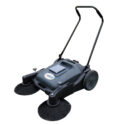
A walk behind scrubber , sometimes called a walk-behind auto scrubber or push-type floor scrubber, is a self-contained machine that:
- Dispenses clean water and detergent onto the floor
- Agitates the surface with a rotating disc brush or cylindrical brush
- Immediately vacuums up the dirty solution through a squeegee and recovery tank
Because scrubbing and drying happen in one motion, there’s no separate mopping, no rinsing step, and no standing water left behind — which matters enormously for slip-and-fall prevention on a working floor.
This separates it from:
- Manual mopping — slow, inconsistent pressure, spreads dirty water around
- Pressure washing — good for outdoor concrete, poor for indoor drainage-free floors
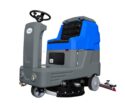
- Ride-on scrubbers — better for very large footprints, but less maneuverable in tight aisles
If your facility also handles wide-open yards or loading exteriors, our guide on choosing between walk-behind and ride-on scrubbers breaks down that decision in more depth.
Why Heavy-Duty Facilities Can’t Rely on Manual Cleaning Alone
Industrial floors face a specific combination of stress factors that push manual methods past their limit:
| Challenge | Why Mopping Fails | What a Scrubber Solves |
|---|---|---|
| Oil & grease residue | Spreads instead of lifting | Brush agitation breaks bond, vacuum removes it |
| Fine dust & metal shavings | Mop heads just relocate particles | Solution suspends particles for extraction |
| Forklift tire marks | Needs repeated scrubbing by hand | Continuous brush pressure across long runs |
| Large floor footprints | Labor-intensive, time-consuming | Wide scrub paths cover more ground per hour |
| Slip hazards from wet floors | Floors stay wet for a long time | Integrated drying leaves floor walk-ready instantly |
For facilities that also deal with hygiene-sensitive zones — food processing, pharma-adjacent storage, or cleanrooms — see our related piece on sanitation standards in food production facilities for compliance-specific guidance.
Where Walk Behind Scrubber Are Used Most
- Warehouses & distribution centers — main aisles, dock areas, staging zones
- Manufacturing plants — production floors, assembly walkways
- Automotive workshops & assembly plants — bays with oil leaks and grease buildup
- Logistics hubs — high-traffic corridors with continuous vehicle movement
- Food & beverage production — sanitation-critical surfaces
Each of these environments has a different combination of floor size, dirt type, and traffic pattern — which is exactly why scrubber selection isn’t one-size-fits-all.
Matching the Right ScrubX Machine to Your Facility
| Model | Best Suited For | |
|---|---|---|
| ScrubX 30 -Folding hand push scrubber | Tight maintenance rooms and equipment bays | |
| ScrubX 40 – Foldable hand push scrubber | Medium storage and support zones | |
| ScrubX 45 – Walk behind scrubber | Assembly zones, workshop floors | |
| ScrubX 50 – Walk behind scrubber | Warehouse aisles, production floors | |
| ScrubX 50D – Assisted self-driving scrubber | Long corridors, logistics facilities | |
| ScrubX 55 – Self-driving scrubber | Large industrial buildings, warehouses | |
| ScrubX MOP – Compact folding scrubber | Offices, break rooms, secondary spaces | |
A quick way to think about it: machine size should scale with floor size, not budget alone. An undersized scrubber on a large warehouse floor just means more passes, more battery cycles, and more labor hours — which erodes the ROI the machine was supposed to deliver.
What to Actually Check Before Buying (Buyer’s Checklist)
Based on installations we’ve supported across Canadian facilities, these are the factors that most affect real-world performance — not just spec-sheet numbers:
1. Scrub Path Width Wider paths cover more square footage per hour, which matters most in open warehouse floors and less in narrow maintenance corridors.
2. Brush Type — Disc vs. Cylindrical Disc brushes handle general dirt and polishing well; cylindrical (roller) brushes tend to perform better on debris, dust, and coarse particles common in manufacturing.
3. Tank Capacity Larger solution and recovery tanks reduce refill stops — critical for facilities running long, uninterrupted shifts.
4. Battery Runtime & Charging Cycle Look at actual run-time under load, not just the advertised maximum, and check whether the charging cycle fits your shift pattern.
5. Water Recovery Efficiency A strong squeegee and vacuum motor determine whether the floor is truly dry after one pass or still damp — directly affecting slip risk.
6. Maintenance Access Machines with tool-free brush and squeegee access reduce downtime significantly over a multi-year service life.
For a deeper technical walkthrough, our floor scrubber maintenance guide covers upkeep schedules that extend machine lifespan.
The Productivity and Safety Case
Facilities that shift from manual mopping to walk behind scrubber typically report:
- Fewer labor hours spent per shift on floor cleaning
- Reduced slip-and-fall incidents due to instant floor drying
- More consistent cleaning results across shifts and staff turnover
- Lower long-term cost per square meter cleaned compared to manual labor
These outcomes align with general findings from workplace safety bodies, which consistently identify wet or contaminated floors as a leading contributor to industrial slip injuries — reinforcing why integrated drying isn’t a convenience feature, it’s a safety one.
Why Canadian Facilities Choose Cleaning Machines
- Field experience — years of equipping warehouses, plants, and logistics hubs across Canada with working knowledge of what actually holds up under daily industrial use
- Full ScrubX range — from compact hand-push units to autonomous robotic scrubbers, covering every facility size
- Local support — parts, servicing, and guidance from a team that understands Canadian commercial cleaning conditions
- Transparent guidance — we match machines to facilities based on floor type and workload, not just the highest-margin unit
Frequently Asked Questions
What is an industrial floor scrubber machine? It’s a machine that washes and dries commercial floors in one pass, using rotating brushes with water and detergent to lift dirt, followed by immediate vacuum extraction of the dirty solution.
Are walk behind scrubbers suitable for warehouses? Yes. Their maneuverability makes them effective for aisles, storage zones, and loading areas where ride-on machines would struggle to fit.
How often should industrial floors be scrubbed? High-traffic warehouses often need daily scrubbing, while lower-traffic manufacturing zones may only need it a few times per week — frequency should follow actual foot and vehicle traffic, not a fixed calendar.
What features matter most in a heavy-duty scrubber? Brush pressure, tank capacity, battery runtime, and squeegee/vacuum efficiency — in that order of impact on daily performance.
What size scrubber is best for large facilities? Wider scrub paths and larger tanks reduce total cleaning time on big floors, making mid-to-large walk behind or self-driving models the better fit over compact units.
