




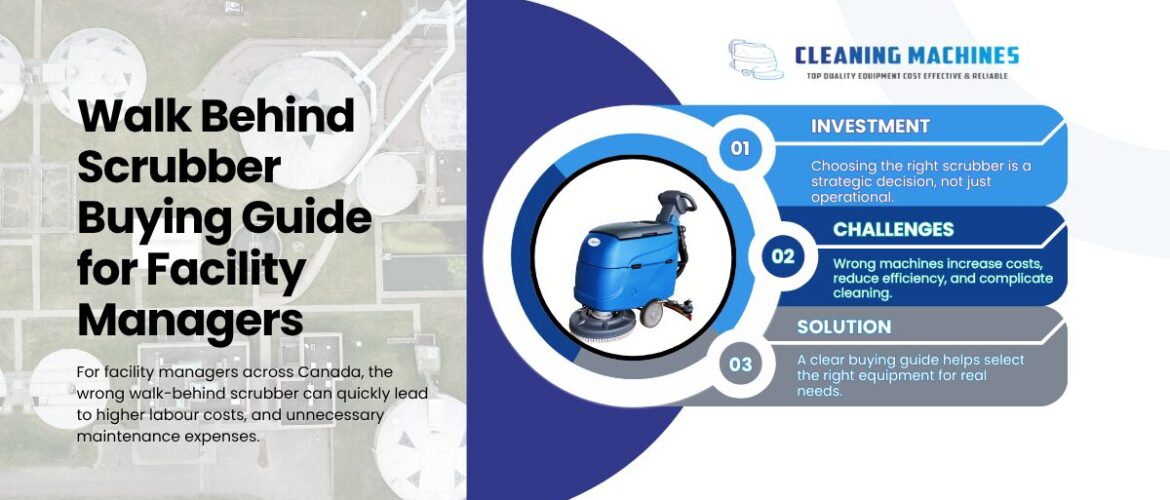
Choosing the right floor cleaning equipment is no longer a simple operational decision—it’s a strategic investment. For facility managers across Canada, the wrong walk-behind scrubber can quickly lead to higher labour costs, inconsistent cleaning results, and unnecessary maintenance expenses.
Many businesses struggle with issues like underpowered machines that fail to clean high-traffic areas properly, or oversized units that are difficult to maneuver in tight spaces. Over time, these mistakes impact both productivity and operational budgets.
That’s why a structured Walk Behind Scrubber Buying Guide is essential. Facility managers need clarity, not confusion, when evaluating options. Increasingly, organizations are turning to trusted providers like Cleaning Machines to find solutions that match real-world cleaning demands—whether in warehouses, retail stores, or commercial buildings.
What Should Facility Managers Consider Before Buying a Walk Behind Scrubber?
Before making a purchase, it’s important to understand that not all scrubbers are built for the same purpose. A mismatch between your facility’s needs and the machine’s capabilities can lead to inefficiencies from day one.
Here are the key factors to evaluate:
- Facility size: Determines cleaning width and tank capacity
- Floor type: Impacts brush type and cleaning pressure
- Cleaning frequency: Daily vs occasional use changes durability requirements
- Budget: Includes both upfront cost and long-term operating expenses
For example, a retail store cleaning daily requires a different machine than a warehouse doing weekly deep cleaning. A properfloor scrubbers selection guide always starts with understanding your environment first—not the machine.
How Does Facility Size Affect Scrubber Selection?
Facility size directly influences productivity. Choosing the wrong size machine can either slow down operations or create unnecessary complexity.
| Facility Size | Recommended Scrubber Type | Key Priority |
| Small (Offices, Shops) | Compact walk-behind | Maneuverability, storage |
| Medium (Retail, Schools) | Standard walk-behind | Balance of power & speed |
| Large (Warehouses, Airports) | Heavy-duty / wide scrubber | Coverage, efficiency |
Small Facilities
Tight areas like offices, classrooms, and small retail spaces require compact machines that are easy to maneuver.
Medium Commercial Spaces
Supermarkets, mid-sized warehouses, and commercial buildings need a balance between coverage and agility.
Large Facilities
Airports, distribution centers, and industrial plants demand machines with wider cleaning paths and larger tanks.
A common mistake in commercial cleaning equipment buying is overestimating size requirements. Larger machines may seem more powerful but can reduce efficiency in confined areas.
For example, in smaller environments, machines like the ScrubX 30 – Folding Hand Push Floor Scrubber provide better control and storage flexibility without compromising cleaning quality.
Practical Tip:
- Measure your cleaning area (in square meters)
- Identify narrow pathways or obstacles
- Match machine width to real usable space—not total floor area
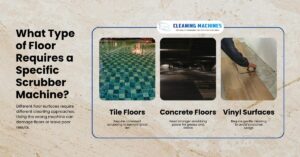
What Type of Floor Requires a Specific Scrubber Machine?
Different floor surfaces require different cleaning approaches. Using the wrong machine can damage floors or leave poor results.
| Floor Type | Cleaning Challenge | Recommended Approach |
| Tile | Dirt in grout lines | Moderate pressure scrubbing |
| Concrete | Grease, heavy debris | High-pressure cleaning |
| Vinyl | Scratch-sensitive | Gentle brushes, low pressure |
Tile Floors
- Require consistent scrubbing to remove grout dirt
- Benefit from moderate brush pressure
Concrete Floors
- Often found in warehouses
- Need stronger scrubbing power for grease and debris
Vinyl and Sensitive Surfaces
- Require gentle cleaning to avoid scratches
- Need controlled water usage
Facility managers often overlook this, leading to reduced floor lifespan or ineffective cleaning.
In environments with mixed flooring types, machines like the ScrubX 45 – Walk Behind Floor Scrubber are often preferred because they provide balanced cleaning performance across different surfaces.
Practical Advice:
- Identify high-risk areas (wet zones, greasy floors)
- Choose adjustable brush pressure if possible
- Avoid “one-size-fits-all” assumptions
Should You Choose a Compact or Heavy-Duty Floor Scrubber?
This is one of the most common decision points for facility managers.
Compact Scrubbers
Best for:
- Small spaces
- Frequent cleaning
- Easy storage
Heavy-Duty Scrubbers
Best for:
- Large industrial areas
- Tough stains and debris
- Long cleaning sessions
The key issue is overbuying. Many facilities invest in heavy-duty machines they don’t fully utilize, increasing costs unnecessarily.
For operations that require flexibility across different cleaning scenarios, machines like the ScrubX 40 – Foldable Hand Push Scrubber offer a practical middle ground between portability and performance.
Buying Tip:
- If your team struggles with maneuverability, go compact
- If cleaning time is too long, consider higher-capacity machines
What Features Should Facility Managers Look for in a Floor Scrubber?
Features directly impact efficiency, usability, and long-term value. However, more features don’t always mean better performance.
| Feature | Why It Matters | Impact on Operations |
| Tank Capacity | Fewer refills | Saves time |
| Cleaning Width | Covers more area per pass | Faster cleaning |
| Battery Runtime | Longer operation | Less downtime |
| Ease of Use | Faster staff training | Higher productivity |
Key Features to Evaluate
- Tank Capacity: Larger tanks reduce refill frequency
- Cleaning Width: Wider paths cover more area quickly
- Ease of Use: Simple controls reduce training time
- Maintenance Access: Easy servicing reduces downtime
- Durability: Essential for daily use environments
A common mistake in industrial scrubber buying tips is paying for features that are rarely used.
For example, in medium-sized commercial settings, machines like the ScrubX 50 – Walk Behind Floor Scrubber are often chosen for their balance of capacity and ease of operation without unnecessary complexity.
Checklist for Buyers:
- Does it reduce labour time?
- Is it easy for staff to operate?
- Can it handle daily usage?
How Important Is Battery Performance in Commercial Scrubbers?
Battery performance plays a critical role in operational efficiency. Poor battery selection can disrupt cleaning schedules and increase downtime.
What to Consider
- Runtime: Should match your cleaning duration
- Charging Time: Impacts shift planning
- Battery Type: Lithium-ion vs lead-acid
Facilities with large areas often underestimate how important continuous runtime is.
For instance, machines like the ScrubX 50D – Two Methods For Self-driving Floor Scrubber are often considered in environments where extended runtime and operational flexibility are important.
Practical Advice:
- Choose runtime slightly higher than your actual need
- Plan charging cycles based on shifts
- Avoid machines with limited battery support
How Can Facility Managers Reduce Long-Term Cleaning Costs?
The purchase price is only part of the total cost. Long-term expenses often come from labour, maintenance, and inefficiencies.
Cost Reduction Strategies
- Choose the right machine size from the start
- Reduce manual labour through efficient cleaning
- Schedule regular maintenance
- Use machines with easy-to-replace parts
One of the biggest hidden costs is labour time. A slightly more efficient machine can significantly reduce overall expenses.
In medium-to-large facilities, machines like the ScrubX 55 – Self-Driving Floor Scrubber can help reduce manual effort and improve consistency, leading to long-term savings.
Key Insight:
- Focus on total cost of ownership—not just purchase price
When Should Businesses Consider Automated or Self-Driving Scrubbers?
Automation is becoming increasingly relevant in commercial cleaning, especially where labour shortages exist.
Benefits of Automation
- Consistent cleaning results
- Reduced labour dependency
- Improved productivity
- Better coverage tracking
However, automation is not always necessary. It works best in large, open environments with repetitive cleaning patterns.
For example, in high-traffic commercial spaces, solutions like the ScrubX Robotics S79 Indoor Commercial Floor Scrubbing Robot can support teams by handling routine cleaning tasks efficiently.
When to Consider Automation:
- Large floor areas
- Limited staff availability
- Need for consistent cleaning standards
How Can Facility Managers Avoid Common Buying Mistakes?
Many purchasing decisions fail due to avoidable mistakes.
Common Mistakes
- Buying oversized machines
- Ignoring maintenance requirements
- Overlooking operator comfort
- Choosing based on price alone
A machine that looks cost-effective upfront may lead to higher operational costs later.
For facilities that need simple and reliable solutions, options like the ScrubX MOP – Folding Hand Push Floor Scrubber can be practical in environments where ease of use and quick deployment are priorities.
Practical Advice:
- Always evaluate real use cases
- Test usability before purchase
- Consider staff feedback
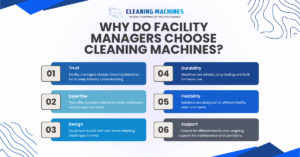
Why Do Facility Managers Choose Cleaning Machines?
Facility managers rely on Cleaning Machines because of their strong understanding of commercial cleaning challenges across industries. From retail and healthcare to warehouses and educational institutions, the brand focuses on practical solutions rather than one-size-fits-all products.
What Sets Cleaning Machines Apart?
- Industry-focused equipment design
- Reliable and durable machines
- Solutions tailored for different facility sizes
- Ongoing support for maintenance and operations
The company’s experience in facility cleaning machines allows it to address real-world problems such as labour shortages, efficiency gaps, and maintenance challenges.
More importantly, Cleaning Machines emphasizes usability and long-term value—two factors that matter most for facility managers making high-impact purchasing decisions.
FAQs
What is the best walk behind scrubber for commercial use?
The best scrubber depends on your facility size, floor type, and cleaning frequency. There is no one-size-fits-all solution. A proper evaluation of your operational needs is essential before choosing a machine.
How do I choose the right floor scrubber for my facility?
Start by analyzing your floor space, surface type, and cleaning requirements. Then compare machine features such as tank capacity, battery life, and maneuverability. Always prioritize practicality over extra features.
What size scrubber do I need?
Small facilities need compact machines, while larger spaces require wider cleaning paths and bigger tanks. The goal is to maximize efficiency without compromising maneuverability.
Are battery-powered scrubbers better?
Battery-powered scrubbers are generally more efficient and easier to use in commercial environments. They reduce manual effort and allow for consistent cleaning performance across large areas.
How long do commercial scrubbers last?
With proper maintenance, most commercial scrubbers can last several years. Regular servicing, proper usage, and timely part replacement significantly extend machine life.
What features matter most when buying a scrubber?
Key features include tank capacity, cleaning width, battery runtime, ease of operation, and maintenance accessibility. These directly impact performance and long-term costs.
Can one scrubber work for all floor types?
Some machines can handle multiple surfaces, but not all. It’s important to match the scrubber’s capabilities with your specific flooring to ensure optimal cleaning and avoid damage.
Is automation worth it for facility cleaning?
Automation is valuable for large facilities with repetitive cleaning needs. It improves efficiency and reduces labour dependency, but may not be necessary for smaller operations.
