

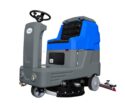

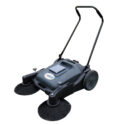


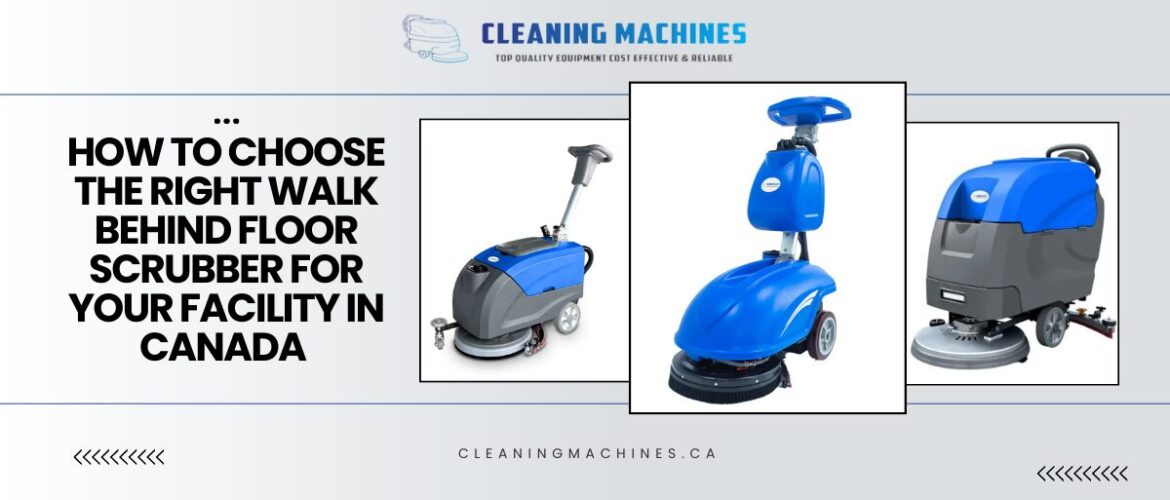
Investing in the Right Walk Behind Floor Scrubber can completely transform how your facility operates. The wrong machine slows your team down, increases labour costs, leaves floors unsafe, and creates constant frustration. The right one improves cleaning speed, reduces slip risks, handles Canadian winter conditions, and lowers long-term operating costs.
Before you buy, you need to evaluate your square footage, cleaning frequency, battery runtime, layout complexity, and staffing capacity. This guide helps you make a confident, practical decision — so you choose equipment that solves problems instead of creating new ones.
Why Do So Many Facilities Regret Their Scrubber Purchase?
Most regret comes down to three mistakes:
- Buying too small to save money
- Ignoring battery runtime
- Not calculating total cleaning hours
In Canada, cleaning challenges are unique:
- Winter salt and slush damage floors
- Large warehouse footprints require long runtime
- Healthcare facilities demand strict sanitation
- Slip-resistance compliance is critical
The wrong machine increases labour costs, downtime, and frustration.
The right machine saves thousands over 3–5 years.
Step-by-Step Framework to Choose the Right Machine
Use this 7-step decision path before buying.
Step 1: What Type of Facility Are You Cleaning?
Start here.
Different facilities have different demands:
| Facility Type | Cleaning Challenge | Ideal Machine Type |
| Retail Stores | Tight aisles, frequent spills | Compact walk behind |
| Schools | Daily traffic, varied floor types | Mid-size scrubber |
| Warehouses | Large open spaces, dust, salt | Large battery scrubber |
| Hospitals | Sanitization, hygiene compliance | Precision-controlled scrubber |
| Manufacturing | Oil, grime, heavy debris | Heavy-duty scrubber |
If your facility includes narrow corridors or elevators, compact models similar to ScrubX 30 – Folding Hand Push Floor Scrubber or ScrubX 40 – Foldable Hand Push Scrubber make sense.
If you manage large commercial spaces, mid-range options like ScrubX 45 – Walk Behind Floor Scrubber are more practical.
Warehouses above 30,000 sq ft often require machines comparable to ScrubX 50 – Walk Behind Floor Scrubber or automation options.
Step 2: How Many Square Feet Do You Clean Daily?
This is the most overlooked factor in commercial scrubber selection.
Use this simple rule:
- Under 10,000 sq ft: Compact walk behind scrubber
- 10,000–30,000 sq ft: Mid-size scrubber
- 30,000–80,000 sq ft: Large battery-powered model
- 80,000+ sq ft: Consider self-driving or robotic scrubber
Do not choose based on price alone. Choose based on cleaning time.
Step 3: How Many Hours Per Day Is Cleaning Required?
Before choosing a machine, take a moment to think about your daily cleaning schedule. Are you running one shift in the evening? Two shifts across the day? Or does your facility require continuous cleaning throughout operations? The number of hours your team spends cleaning every day directly impacts the type of battery system you should choose.
Why Battery Runtime Impacts Productivity
Battery runtime matters more than most buyers initially realize. A machine with a 2-hour battery may work perfectly for a small retail store that cleans once per day. Schools and office buildings typically need 3–4 hours of runtime to comfortably finish hallways, classrooms, and shared spaces without interruption. Large warehouses, especially in Canada where winter salt and debris increase scrubbing time, often require 4–6 hours of consistent operation.
What Happens When the Battery Dies Mid-Shift?
If a battery dies in the middle of a shift, productivity drops immediately. Staff either wait for charging or switch to manual cleaning, which increases labour time and can effectively double cleaning costs for that day. This is why many facilities are moving toward lithium battery systems. Newer machines, such as the ScrubX 55 – Self-Driving Floor Scrubber, use lithium technology to provide longer runtime, faster charging, and reduced long-term maintenance compared to traditional battery systems.
Step 4: What Tank Capacity Is Ideal?
Tank size determines refill frequency.
Smaller tanks:
- Easier to maneuver
- More refills
- More downtime
Larger tanks:
- Fewer refills
- Better for big areas
- Slightly heavier machine
Rule of thumb:
If staff refill more than 3–4 times per shift, the tank is too small.
In Canadian winters, salt buildup increases water usage. Plan for 10–15% more solution capacity during winter months.
Step 5: Should You Choose Manual, Assisted, or Robotic?
Let’s simplify it.
Manual Walk Behind
- Lower upfront cost
- Full operator control
- Best for small spaces
Self-Propelled / Assisted
- Reduces operator fatigue
- Ideal for mid-large areas
- Balanced cost vs performance
Robotic / Autonomous
- Minimal labour
- Consistent cleaning paths
- Higher upfront cost
- Best for large open facilities
Facilities exploring automation in 2026 often evaluate systems like ScrubX Robotics S79 Indoor Commercial Floor Scrubbing Robot — particularly warehouses and distribution centers.
Comparison: Manual vs Self-Driving vs Robotic
| Feature | Manual | Self-Propelled | Robotic |
| Labour Required | High | Moderate | Low |
| Upfront Cost | Low | Medium | High |
| Productivity | Moderate | High | Very High |
| Best For | Small sites | Mid-large sites | Large open facilities |
| Training Required | Low | Medium | High |
How Does Tank Refill Frequency Affect Productivity?
Every refill costs:
- 5–10 minutes
- Lost productivity
- Water waste
If refills happen 5 times daily:
- 50 minutes lost
- 250 hours annually
Larger tank capacity often reduces operational friction.
Step 7: What Maintenance Costs Should You Expect?
Over 3–5 years, consider:
- Battery replacement
- Squeegee blade wear
- Brush replacement
- Filter maintenance
Lithium batteries reduce replacement frequency compared to lead-acid.
Energy-efficient machines also align with Canadian sustainability goals.
Canadian-Specific Buying Considerations (2026)
Winter Salt & Slush
Machines must handle:
- Corrosive residue
- Heavy grime
- Extra moisture
Choose durable squeegee systems.
Healthcare Standards
Healthcare administrators must prioritize:
- Consistent water pickup
- Sanitization compliance
- Low-noise operation
Slip Resistance Compliance
Dry floors reduce liability risks.
Effective vacuum recovery is critical in schools and public buildings.
Sustainability & Energy Efficiency
2026 buyers increasingly evaluate:
- Water usage efficiency
- Battery type
- Chemical consumption
Energy-efficient scrubbers reduce operating costs and environmental impact.
If Your Facility Looks Like This, Choose This Type
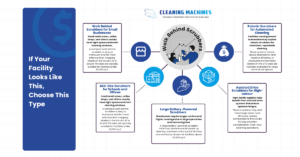
- Small retail store, coffee shop, or clinic: Compact walk behind scrubber (similar to ScrubX 30 or ScrubX 40 class)
- School corridors and office spaces: Mid-size scrubber (comparable to ScrubX 45 range)
- Distribution warehouse: Large battery-powered scrubber (similar to ScrubX 50 class)
- High-labour logistics hub: Assisted drive or self-propelled model (like ScrubX 55 type)
- Facilities planning automated cleaning: Robotic scrubber category (such as S79 class)
Use models as reference points — not marketing claims.
What Mistakes Do Buyers Commonly Make?
- Buying based on price only
- Ignoring square footage
- Overestimating staff capacity
- Underestimating refill downtime
- Not planning for winter conditions
- Skipping demo testing
Red Flags Before Buying
- No runtime clarity
- No service support in Canada
- No training offered
- Unclear warranty terms
- Poor water recovery performance
Always ask for real-world demonstration data.
How Long Should a Commercial Scrubber Last?
With proper maintenance:
- 5–8 years typical lifespan
- Lithium battery systems often extend usability
- Preventive maintenance reduces total ownership cost
A well-chosen machine becomes a long-term asset — not an expense.
Frequently Asked Questions
What size scrubber is best for a 20,000 sq ft warehouse?
For a 20,000 sq ft warehouse, a mid-to-large walk behind scrubber with extended battery runtime is the most efficient choice. Compact machines will require frequent refilling and multiple passes, increasing labour time and reducing productivity. Look for strong suction and longer runtime for uninterrupted cleaning.
Are robotic scrubbers worth the investment?
Robotic scrubbers are cost-effective in large, structured facilities with predictable cleaning routes, such as warehouses, malls, or airports. However, in smaller or cluttered environments, the return on investment may not justify the higher upfront cost. Layout consistency is key.
How long should a commercial scrubber battery last?
Most professional scrubber dryers offer 3–6 hours of runtime depending on battery type, floor condition, and cleaning intensity. Facilities with longer shifts should prioritize higher-capacity batteries to avoid mid-shift downtime and productivity loss.
How often do tanks need refilling?
Tank refilling depends on machine size and soil level. In mid-size facilities, expect 2–4 refills per shift. Larger tank capacities reduce interruptions and improve cleaning efficiency in high-traffic areas.
Is a foldable scrubber good for small businesses?
Yes, foldable or compact models are ideal for facilities under 10,000 sq ft with tight aisles and limited storage space. They are easier to maneuver, store, and operate without sacrificing professional cleaning results.
What’s the lifespan of a commercial scrubber dryer?
With proper maintenance and regular servicing, a commercial scrubber typically lasts 5–8 years. Batteries, squeegees, and brushes are wear components and may require replacement during that period to maintain optimal performance.
