




Facility managers across Canada — from warehouse supervisors to hospital operations directors — eventually face the same decision: should you invest in a battery powered floor scrubber or a corded electric scrubber dryer? After specifying and servicing walk-behind scrubbers for warehouses, retail chains, schools, and healthcare facilities for years, we’ve seen firsthand that the “right” answer depends less on the machine and more on your floor plan, power access, and cleaning frequency.
This guide breaks down exactly how battery and corded auto scrubbers differ, which commercial environments each one suits best, and how to match your facility to the right walk-behind scrubber dryer — including where each model in the ScrubX lineup fits in.
Quick Answer
| If your facility has… | Choose |
|---|---|
| Large open floors (warehouses, malls, airports) | Battery powered scrubber |
| Small, single-room spaces near outlets | Corded scrubber dryer |
| High foot traffic or patient areas | Battery powered scrubber (no trip hazard) |
| Budget-first, occasional cleaning | Corded scrubber dryer |
What Is a Walk-Behind Floor Scrubber?
A walk-behind floor scrubber (also called an auto scrubber, scrubber dryer, or industrial floor scrubbing machine) is commercial cleaning equipment that washes, scrubs, and dries hard floors in a single pass. Unlike a mop and bucket, which spreads dirty water across the surface, a scrubber dryer combines three functional systems:
- Rotating brushes or pads that agitate and lift dirt, grease, and stains
- Clean water and detergent tanks that continuously supply cleaning solution
- A recovery tank with squeegee and vacuum that pulls up dirty water and leaves the floor dry and safe to walk on almost immediately
This single-pass design is why scrubber dryers have become standard equipment in warehouses, hospitals, schools, airports, and retail environments — they reduce labor hours, improve slip-and-fall safety, and produce more consistent hygiene results than manual mopping.
The core difference between models isn’t what they clean — it’s how they’re powered. That’s where the battery vs corded decision comes in.
Battery Powered Floor Scrubbers: How They Work
A battery powered floor scrubber (or cordless scrubber dryer) runs on rechargeable batteries — typically sealed lead-acid, gel, or lithium-ion — instead of a direct electrical connection. Because there’s no cable tethering the machine to a wall outlet, operators can move freely across an entire facility without stopping to find a new plug point.
Typical battery runtime: 2–6 hours, depending on battery chemistry, machine size, and pad pressure settings. Lithium-ion battery scrubbers generally offer faster charging and more consistent power delivery across the discharge cycle compared to older lead-acid systems.
Best suited for:
- Large-format warehouses and distribution centers
- Shopping malls and multi-tenant retail corridors
- Airports and transit hubs
- Hospitals and healthcare facilities
- Logistics and manufacturing floors
Why Facilities Choose Cordless Scrubbers
- Unrestricted mobility — no cable length limits how far an operator can travel
- Improved workplace safety — eliminates cable-related trip hazards in high-traffic zones
- Higher productivity per shift — no downtime spent unplugging, relocating, and re-plugging
Corded Electric Scrubber Dryers: How They Work
A corded scrubber dryer plugs directly into a standard electrical outlet and draws continuous power for as long as it’s connected. Because it isn’t dependent on a battery, it never loses cleaning power mid-shift and doesn’t require a charging routine between uses.
Best suited for:
- Small retail shops and boutiques
- Offices, reception areas, and lobbies
- Restaurants and commercial kitchens
- Schools, clinics, and smaller institutional spaces
Why Facilities Choose Corded Scrubbers
- Continuous, unlimited runtime — no battery to monitor or recharge
- Lower upfront cost in many cases, since there’s no battery pack to purchase
- Simple maintenance — no charging cycles, battery health checks, or replacement schedules
The trade-off is mobility: operators must manage the cable, stay within reach of an outlet, and occasionally stop to switch power points in larger spaces — which can slow down cleaning in anything beyond a small or mid-sized floor plan.
Battery vs Corded Floor Scrubber: Side-by-Side Comparison
| Feature | Battery Powered Scrubber | Corded Scrubber Dryer |
|---|---|---|
| Power source | Rechargeable battery pack | Direct electrical outlet |
| Mobility | Unrestricted movement | Limited by cable length |
| Ideal floor size | Large (warehouses, malls) | Small to medium (offices, shops) |
| Safety | No cable, reduced trip risk | Cable can create hazards in busy areas |
| Runtime | 2–6 hours per charge | Unlimited while plugged in |
| Maneuverability | Easier in open, wide areas | Requires cable management |
| Maintenance | Battery charging + periodic replacement | Minimal, but cable wear over time |
| Typical use case | Warehouses, hospitals, airports, industrial sites | Offices, clinics, small retail |
Which Facilities Benefit Most From Each Type?
Warehouses & Distribution Centers — Wide aisles and continuous floor runs favor battery powered scrubbers, which let operators clean without interruption. A heavy-duty option like the ScrubX 50 Walk Behind Floor Scrubber is built for this kind of large-area coverage.
Shopping Malls & High-Traffic Retail — Long corridors and constant foot traffic make cordless mobility and cable-free safety a priority. Facilities managing mixed layouts often choose a flexible option like the ScrubX 50D Two-Method Self-Driving Scrubber.
Hospitals & Healthcare Facilities — Patient safety comes first, and a battery powered scrubber removes cable trip risk entirely in corridors and wards.
Small Retail Stores, Clinics & Offices — Limited floor space and easy outlet access make a compact corded or hybrid unit practical, such as the ScrubX 30 Folding Hand Push Floor Scrubber or ScrubX 40 Foldable Hand Push Scrubber.
Supermarkets & Educational Institutions — Moderate-to-large floors with daily cleaning needs are well matched to a balanced machine like the ScrubX 45 Walk Behind Floor Scrubber.
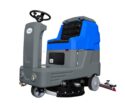
Airports, Convention Centers & Large Public Facilities — Heavy daily traffic and long shifts call for reduced operator fatigue, which is where a ScrubX 55 Self-Driving Floor Scrubber adds value.
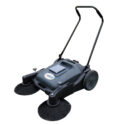
Quick Spot Cleaning & Spill Response — For fast touch-ups between shifts rather than full-facility cleaning, a compact unit like the ScrubX MOP Folding Hand Push Scrubber is a practical addition alongside a primary machine.
Facilities Moving Toward Automation — Sites that need frequent cleaning throughout operational hours, without pulling staff off other tasks, are increasingly adopting autonomous equipment such as the ScrubX Robotics S79 Indoor Commercial Floor Scrubbing Robot.
How to Choose the Right Walk-Behind Scrubber: A Buyer’s Checklist
Before purchasing, weigh these factors against your facility’s actual operating conditions:
- Floor area — Larger spaces justify the higher productivity of battery powered or ride-on units.
- Floor surface type — Concrete, tile, epoxy, and vinyl floors may call for different brush or pad configurations.
- Cleaning frequency — Daily cleaning schedules demand more durable, commercial-grade construction.
- Battery runtime and charge cycle — For cordless machines, match battery capacity to your longest uninterrupted cleaning session.
- Operator comfort — Ergonomic handles and intuitive controls reduce fatigue during extended shifts.
- Certifications and build quality — Important for industrial and regulated environments like healthcare and food processing.
- Total cost of ownership — Factor in battery replacement, cable maintenance, water/detergent use, and labor hours saved.
Why Facility Managers Trust ScrubX Cleaning Machines
Choosing commercial cleaning equipment is a long-term operational decision, not just a purchase — which is why experience and reliability matter as much as specifications. The ScrubX lineup is built specifically for Canadian commercial environments, with:
- Durable, industrial-grade construction tested for daily commercial use
- A model range covering compact folding scrubbers through self-driving and fully autonomous robotic units
- Equipment used across retail, healthcare, logistics, education, and industrial sectors
- Ongoing manufacturer support for parts, maintenance, and operator training
This range means facilities aren’t forced into a one-size-fits-all machine — they can match equipment precisely to floor size, layout, and cleaning frequency.
Frequently Asked Questions
What is the difference between battery and corded floor scrubbers? Battery floor scrubbers run on rechargeable batteries for cordless, unrestricted movement. Corded scrubbers connect to a power outlet for continuous, unlimited runtime but require cable management during use.
Are cordless floor scrubbers better for large facilities? Generally yes. Cordless scrubbers let operators cover warehouses, malls, and industrial floors without stopping to manage cables or switch outlets.
How long do scrubber dryer batteries last? Most commercial battery scrubbers run for 2–6 hours per charge, depending on battery type and machine size. Lithium-ion batteries typically offer more consistent performance across the full runtime.
Are corded floor scrubbers still used in commercial cleaning? Yes. They remain a practical, lower-maintenance choice for smaller facilities such as offices, clinics, and boutique retail spaces with easy outlet access.
Which walk-behind floor scrubber is best for warehouses? Battery powered walk-behind scrubbers, such as the ScrubX 50 or ScrubX 55, are typically best for warehouses due to their uninterrupted mobility across large floor areas.
What features should buyers look for in a commercial scrubber dryer? Cleaning path width, battery runtime (for cordless models), tank capacity, brush/pad type, and overall build durability are the key specifications to evaluate against your facility’s floor size and cleaning schedule.
